
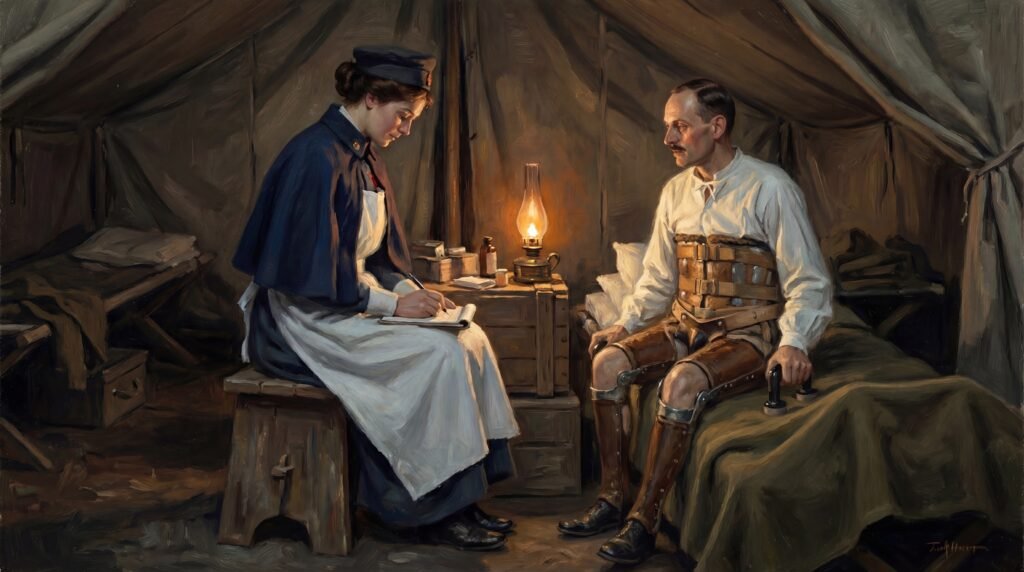
The Longest Night: Dominikus Müller and the Arras Offensive
The entry in the German Verlustlisten (Casualty Lists) is brief, a single line in a sea of names printed in blackletter font. “Müller, Dominikus. Schwer verwundet, 25.4.1917.”– Schwer verwundet 1917, (Severely wounded, April 25, 1917).
To the military archivists in Berlin, he was a statistic—one of thousands of casualties during the Battle of Arras. To the men of the Bavarian Infantry Regiment, he was a comrade who didn’t answer roll call. But the story behind that date reveals the agony of the “Lazarett” (Field Hospital) system and the quiet, devastating hope that the words “severely wounded” gave to a family waiting back home—a hope that was often crueler than the truth.
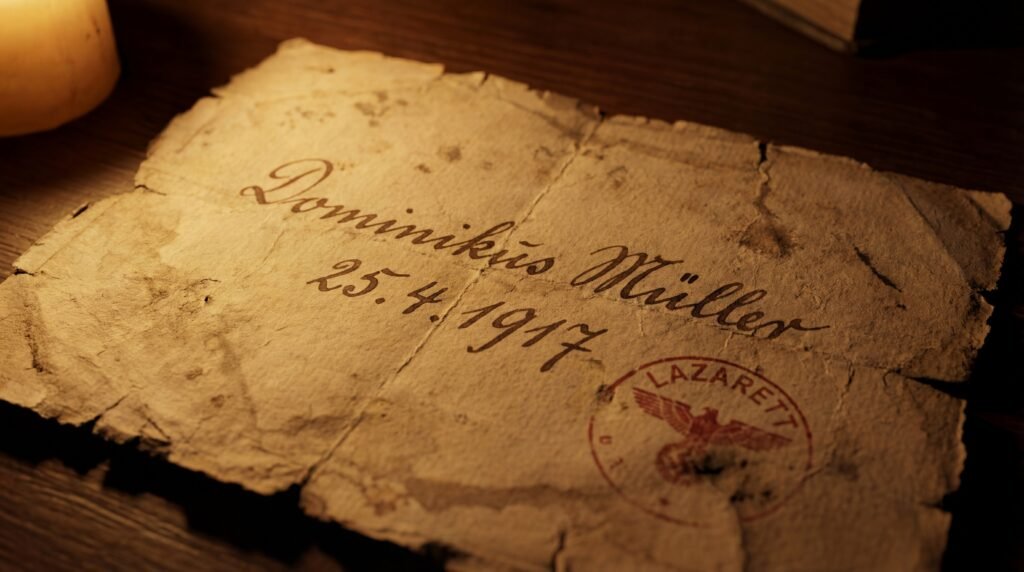
The calm before the barrage | Schwer verwundet 1917
Dominikus Müller was twenty-two years old, a farmer’s son from a small village in Upper Bavaria. He had been at the front for fourteen months. By April 1917, the Western Front had turned into a moonscape. The Battle of Arras was raging. The British forces were launching massive assaults, utilizing a terrifying new tactic: the creeping barrage.
On the morning of April 25, 1917, Dominikus was stationed in a reserve trench near the village of Monchy-le-Preux. The weather was unseasonably cold; the ground was a mixture of half-frozen mud and chalk. At 04:30, the horizon turned white. The British artillery opened up.
25.4.1917: The Impact
The shell that found Dominikus didn’t kill him instantly. It exploded on the parados of the trench, sending a spray of hot iron shrapnel through the air. Dominikus was thrown against the trench wall.
When the dust settled, he was alive, but his body was shattered. A piece of shrapnel had pierced his lung; another had shattered his right femur. He lay in the mud, unable to move, while the battle raged over his head. For four hours, he waited. The Krankenträger (stretcher-bearers) couldn’t reach him due to the intensity of the machine-gun fire. He pressed a field dressing to his chest, his breath coming in ragged, bloody gasps. He was alone in the noise.
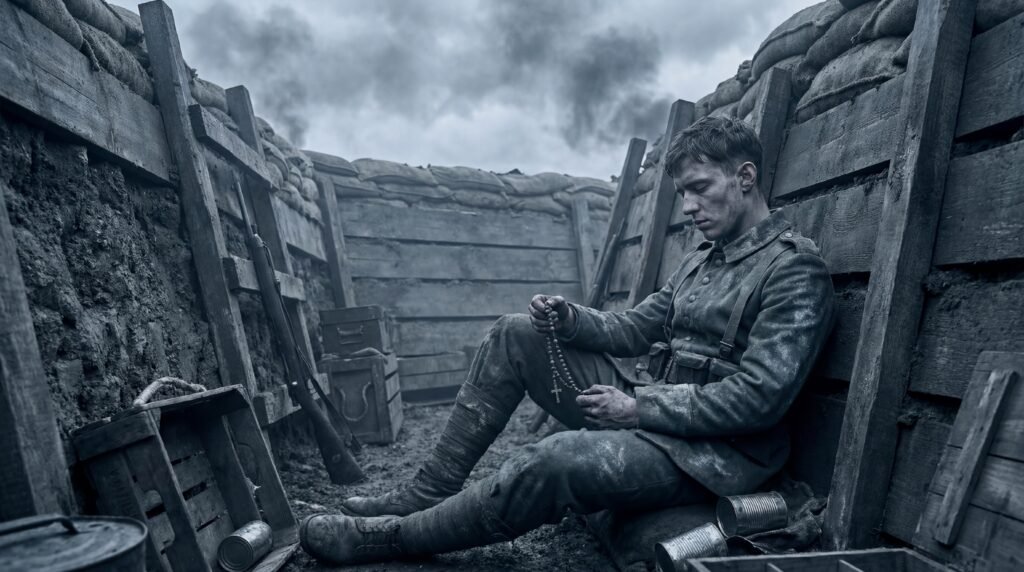
The Journey to the Rear
At 09:00, a lull in the fighting allowed two bearers to drag him onto a canvas stretcher. The journey back to the Feldlazarett (Field Hospital) was a gauntlet of pain. Every slip in the mud, every jolt of the cart, sent shockwaves through his broken body.
By the time he reached the triage tent, he was grey-faced from blood loss. The doctors tagged him: “Schwer verwundet.” It was a classification that prioritized him for surgery, but also signaled to the staff that his chances were slim.
The Letter Home
This is where the tragedy of Dominikus Müller deepens. On the evening of April 25th, a nurse sat by his cot. Dominikus was too weak to hold a pen. He dictated a letter to his parents.
“Dear Mother, Dear Father. I have been hit. It is bad, but I am out of the fighting now. The doctors are kind. I am warm. Do not worry. I will be home for the harvest. Your son, Dominikus.”
He lied. He knew he wouldn’t be home for the harvest. But the instinct to protect his family was stronger than the pain. That letter would travel by train to Bavaria, arriving two days before the official telegram.
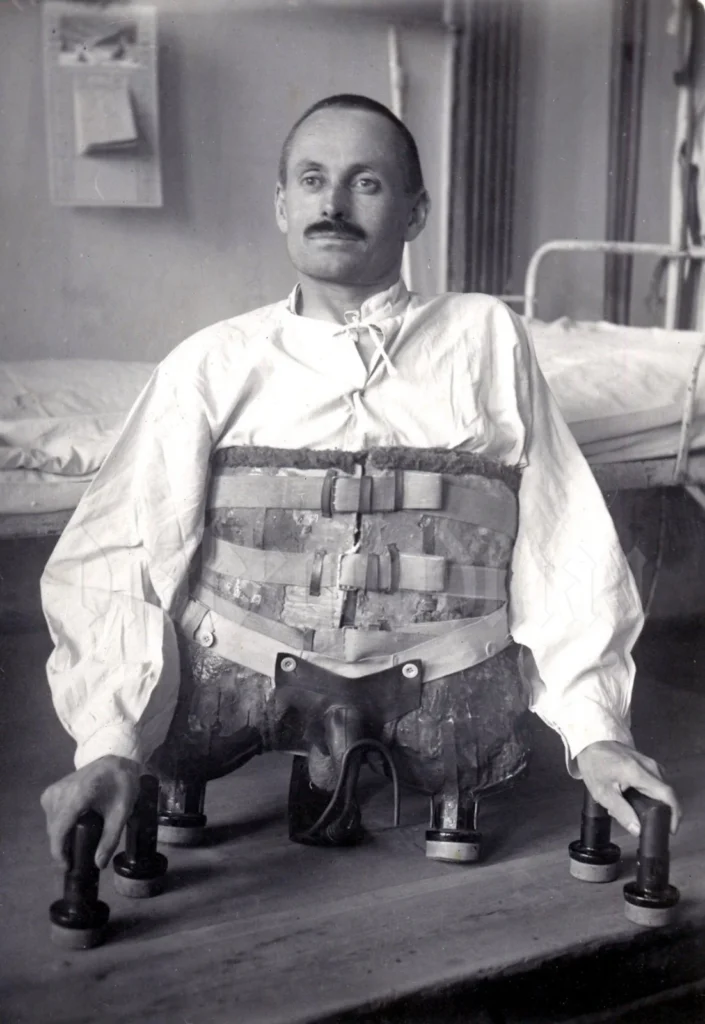
The End of Hope
Dominikus fought for three days. The infection—gas gangrene—set in, a common killer in the manure-rich soil of French farmlands. On April 28, 1917, the classification on his chart changed from Schwer verwundet to Gestorben (Died).
When his parents received the first letter, they rejoiced. “Severely wounded” meant he was alive. It meant he was coming home. They went to church to light a candle of thanks. Two days later, the official telegram arrived. The hope that had been sparked by the “wounded” status made the grief of the final news twice as heavy.
Dominikus Müller was buried in a mass grave behind the lines, later moved to the German War Cemetery at Saint-Laurent-Blangy. The only physical remnant of his life is the paper trail: a birth certificate, a conscription notice, and the entry: Schwer verwundet 25.4.1917.