

Everyone praises hard work. Almost no one talks about wasted effort.
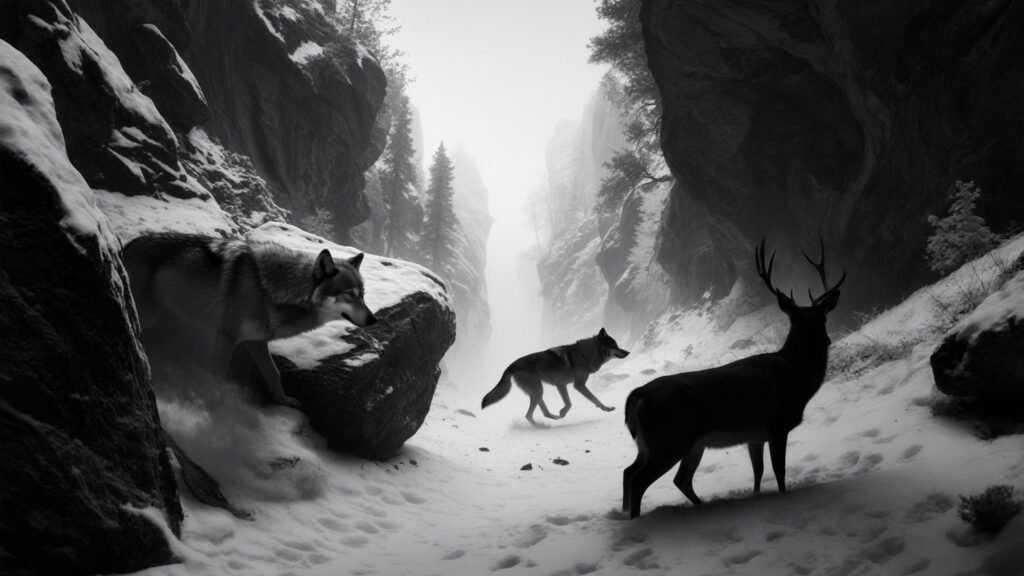
One brutal winter, snow buried the forest. Food was scarce. Two wolves went hunting together: one Young, one Old.
The Young Wolf was fast, strong, full of fire.
A rabbit flashed past and he exploded into a sprint, chasing it over three hills, breath steaming in the cold air. The rabbit slipped into a deep burrow and vanished.
The Young Wolf returned exhausted and hungry, comforting himself: “At least I tried my best.”
Soon after, he spotted a squirrel in a tree.
He lunged, barked, clawed at the trunk. The squirrel leapt away and disappeared.
The Young Wolf collapsed into the snow, drained.

He looked at the Old Wolf.
All morning, the Old Wolf had moved slowly. Sometimes sniffing the wind. Sometimes lying still beneath a dead tree, eyes half-closed as if asleep.
Annoyed, the Young Wolf snapped:
“You’re lazy. We’re starving and you won’t even run or chase. Food doesn’t just fall into your mouth.”
The Old Wolf opened his eyes calmly.
“I’m not lazy,” he said. “I’m calculating.”
He rose and walked toward a narrow canyon where the only stream hadn’t fully frozen. He hid behind a large rock, downwind.
“You chased rabbits and squirrels,” he whispered.
“They cost a lot of energy and give very little return. You spent ten units of effort to get two units of food. That’s a loss.”
“Watch.”

A large deer, desperate for water, was forced to pass through the canyon. Deep snow slowed it down. When it entered the choke point, the Old Wolf made a single move.
Clean. Precise.
That night, the Old Wolf was full.
The Young Wolf, despite all his speed and effort, survived on leftovers.
The Logic Behind the Story
1. Blind effort wastes resources
We glorify being “busy,” but logic is simple:
Effectiveness = Results ÷ Energy spent
– The Young Wolf represents busy effort: lots of movement, low payoff.
– The Old Wolf represents ROI thinking: act only when the return is worth the cost.
2. Position beats speed
The Young Wolf trusted speed.
The Old Wolf chose position: the right place, the right wind, the right moment.
In life and business, where you stand often matters more than how hard you run.
3. Strategic patience always wins
The Old Wolf didn’t wait out of laziness. He waited because probability was on his side.
Big prey must come to water.
Patience guided by logic beats urgency driven by emotion.
CORE LESSON:
Don’t confuse being busy with being effective.
In a world of limited energy, the winner isn’t the fastest runner. It’s the one who knows when to move and when to stay still.
If you stopped chasing today, would your life get better… or would your ego panic?