
Why Nature’s Amazing Inventions Are the Secret to Modern Safety
Just a cat, yet it saved a British man from his certain death and became the reason for saving millions of lives. In 1933, Percy Shaw was driving through a thick fog when the reflection of his headlights in a cat’s eyes guided him away from a dangerous precipice.
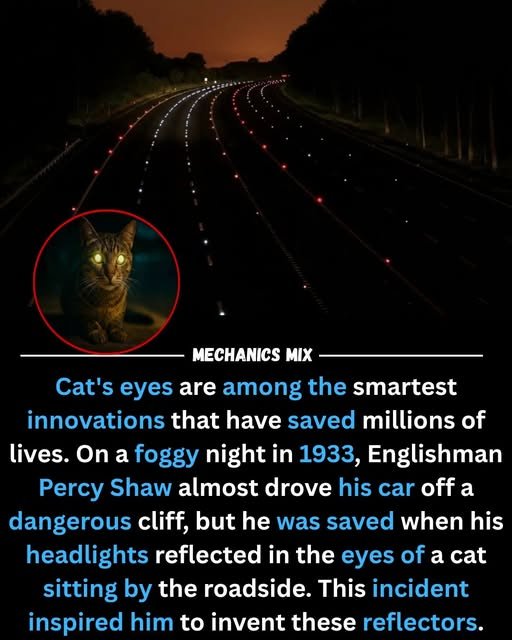
This life-changing moment led him to invent “Cat’s Eyes,” the ingenious road studs that use reflective glass to map out the darkness for drivers. Today, these markers use a specific color code to communicate vital information: white studs define lane markings, red warns of the road’s left edge, and amber indicates the central reservation or the fast lane’s edge.
Beyond their guidance, these studs are a masterpiece of functional engineering, featuring a self-cleaning mechanism that activates every time a car tires press them down. In more complex road layouts, green reflectors are used to highlight slip roads and lay-bys, ensuring a clear path through any environment. By mimicking the biological brilliance of a feline’s gaze, Shaw turned a near-tragedy into a universal standard of road safety. His legacy lives on in every flicker of light that guides a traveler home, proving that nature’s simple designs are often the most powerful solutions to human problems.
The Genius of Biology: A Guide to Nature’s Amazing Inventions
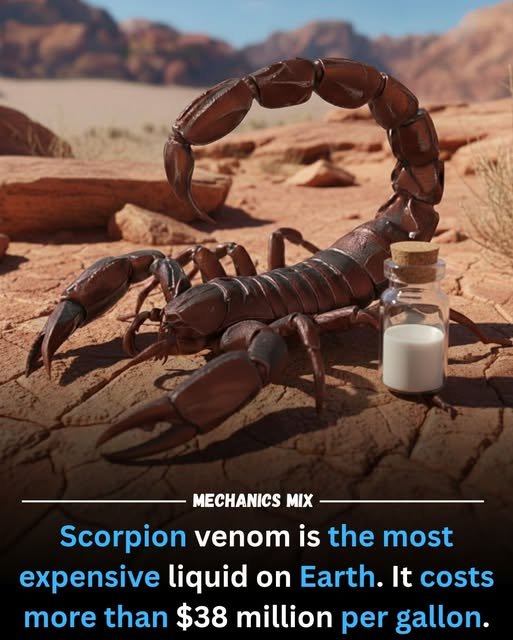
While you might think of a vintage Chanel perfume or a rare aged scotch as the pinnacle of luxury, they don’t even come close to the staggering price of scorpion venom. At over $38 million per gallon, this lethal cocktail is officially the most expensive liquid on the planet. The reason for this eye-watering cost isn’t just the danger involved in “milking” a scorpion, but the sheer inefficiency of the process; a single scorpion produces only a tiny droplet of venom at a time, meaning you would have to milk one individual nearly 2.6 million times just to fill a gallon jug.
Despite its reputation for causing pain, this liquid gold is highly coveted by the medical community for its life-saving potential. The venom contains specific proteins and compounds that scientists are using to develop breakthroughs in cancer treatment, such as “tumor paint” that highlights cancer cells for surgeons. It is also being researched for its effectiveness in treating malaria and autoimmune diseases. Because each drop is a complex biological pharmacy, researchers are willing to pay a premium for the chance to turn nature’s deadliest defense into humanity’s most advanced medicine
Beyond Human Design: The Power of Nature’s Amazing Inventions
Imagine a creature that defies the typical boundaries of the forest floor, launching itself into the night sky with breathtaking grace. Despite its name, the flying squirrel doesn’t actually fly like a bird; instead, it uses a specialized furry membrane called a patagium that stretches from its wrists to its ankles, acting like a built-in paraglider. This remarkable adaptation allows it to leap from the highest canopies and glide through the air for distances up to 90 meters—nearly the length of an entire football field—all in a single, silent swoop.
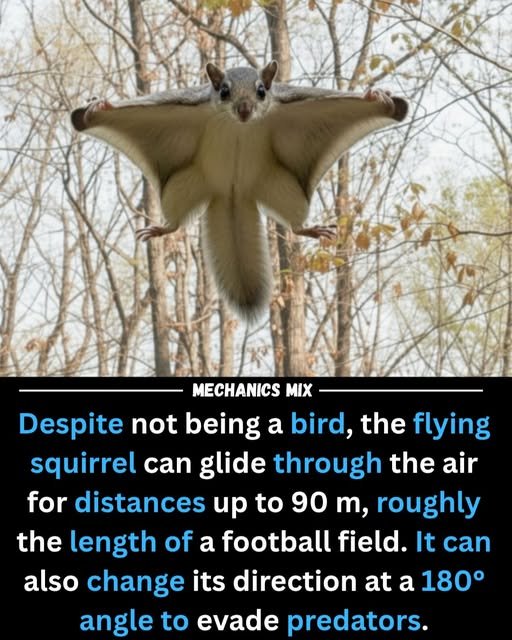
What is truly mind-blowing about these nocturnal acrobats is their incredible mid-air agility. They don’t just drift aimlessly; they use their flat tails as rudders to steer through dense branches with surgical precision. When a predator like an owl gives chase, the flying squirrel can execute a sharp 180° hairpin turn in mid-glide, instantly reversing its direction to vanish into the shadows. Watching one in action is like seeing a tiny, furry superhero navigate the treetops, proving that you don’t need feathers to master the art of the air.