
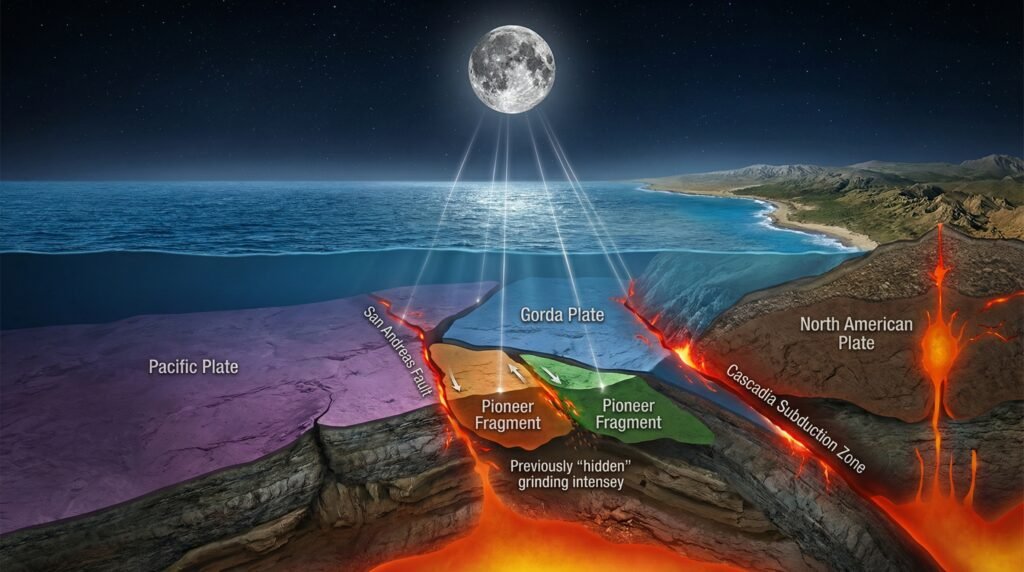
San Andreas Fault Risk: New Tectonic Discovery 2026
Beneath the ocean floor off Northern California, scientists have discovered a complex and hidden tectonic system that could reshape how we understand earthquake risk in the region. By tracking thousands of tiny, low-frequency earthquakes, so small humans can’t feel them, researchers have revealed new details about the Mendocino Triple Junction, where the San Andreas Fault meets the Cascadia subduction zone. This volatile region is capable of generating powerful earthquakes, and the new findings show its underground structure is far more complicated than previously believed.
Using dense seismic networks and even Earth’s tidal forces from the Moon and Sun, scientists confirmed that these micro-earthquakes follow the slow motion of tectonic plates deep below the surface. The study reveals that instead of three plates interacting here, there are actually five moving pieces, including two hidden fragments buried underground. One of them, called the Pioneer fragment, is being dragged beneath North America by the Pacific Plate, helping explain why a major magnitude-7.2 earthquake in 1992 struck at an unexpectedly shallow depth.
This discovery forces scientists to rethink where major faults really lie and how deep earthquake ruptures can occur. If plate boundaries are not where we thought, then seismic hazard models may need updating, especially for one of California’s most dangerous fault zones. Understanding these invisible processes is critical for improving earthquake forecasts and preparedness in the future. Even beneath well-studied regions, Earth is still hiding powerful secrets.
📌 Source:
Shelly, D. R. et al. (2026). Low-frequency earthquakes track the motion of a captured slab fragment. Science, January 15, 2026.
For more fascinating updates on space science and Earth, follow Deep In Space – The Science Hub