
Greenland Glacier Cracking: New Climate Study
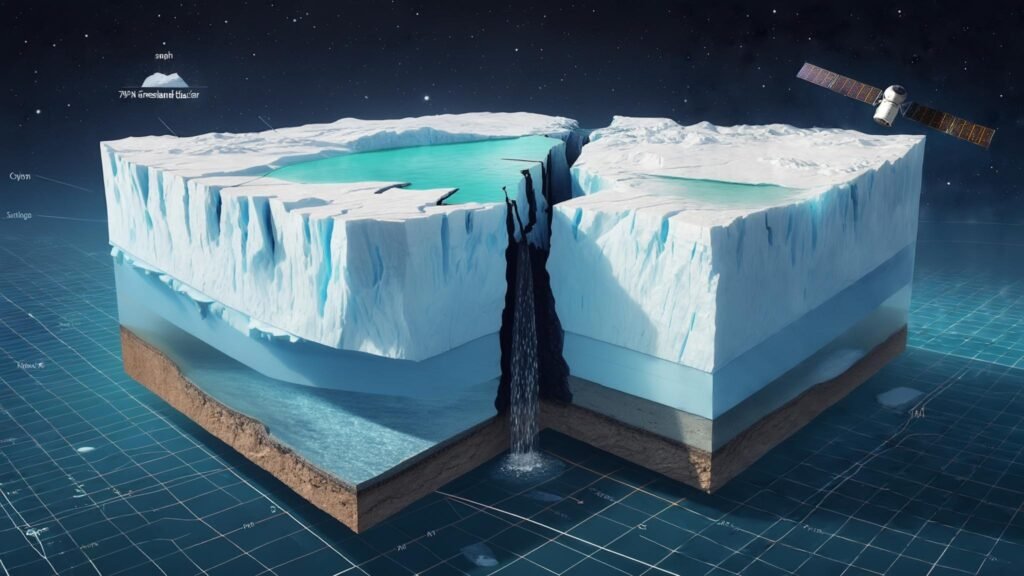
A vast glacier in northeast Greenland is cracking apart.
It’s happens as huge lake of meltwater repeatedly drains through it, giving scientists a rare real-time view of how warming is reshaping the ice.
The Nioghalvfjerdsbræ, or 79°N Glacier, is one of only three remaining floating glacier tongues in Greenland. Since a large surface lake first appeared there in 1995, rising air temperatures have fueled repeated, sudden drainages of its water through newly formed cracks and vertical shafts in the ice.
These events send enormous pulses of fresh water from the glacier’s surface to its base and on toward the ocean, leaving behind triangular fracture fields and deep channels that can remain detectable for years. Radar and aerial images show that this meltwater is even lifting parts of the glacier by feeding a hidden lake beneath the ice, creating a blister-like bulge and long-lasting structural weaknesses.
The new research reveals that the glacier ice behaves in a complex way—flowing slowly like a very thick liquid while also flexing and cracking like an elastic solid. This dual nature allows drainage channels to open rapidly during melt events and then gradually close as the ice creeps and deforms. Yet in recent years the lake has been draining more often, with four of seven major events occurring in just the past five years, suggesting that the glacier may be shifting into a new, less stable state. Scientists from the Alfred Wegener Institute and partner universities are combining satellite data, airborne measurements, and computer models to understand whether this heavily fractured system can still “reset” each winter or whether repeated extreme melt events are permanently altering how the glacier drains and flows. Their work is crucial for improving ice-sheet models and for predicting how continued atmospheric warming will affect the future stability of Greenland’s ice and global sea levels.
References (APA style)
Alfred Wegener Institute, Helmholtz Centre for Polar and Marine Research. (2025, December 29). A Greenland glacier is cracking open – and scientists are watching it drain in real time. SciTechDaily.