She was 17, and the law said she had to marry her rapist—or be dishonored forever.
She said no.
In 1965, Franca Viola was a teenager living in Alcamo, Sicily, when she made a decision that would change Italian history. But first, she had to survive.
Franca had ended a relationship with Filippo Melodia, a man with mafia connections who didn’t accept rejection. On December 26, 1965, Melodia and a group of armed men stormed her family’s home. They beat her mother. They abducted Franca and her eight-year-old brother Mariano, who tried desperately to protect his sister.
Mariano was released. Franca was not.
For eight days, she was held captive. Raped. Terrorized. And constantly pressured to agree to marry her attacker.
Because in 1965 Italy, that was the solution. That was the law.
Article 544 of the Italian Penal Code allowed a rapist to escape all punishment if he married his victim. It was called “matrimonio riparatore”—rehabilitating marriage. The idea was that marriage would “restore” the woman’s honor, which had been destroyed by the rape.
Her honor. Not his crime.
This wasn’t ancient history. This was 1965—the year the Beatles released “Yesterday,” the year America sent troops to Vietnam. In modern Italy, rape victims were expected to marry their rapists or live as damaged, unmarriageable outcasts.
When Franca was finally released after eight days, everyone—her community, society, even some in her own family—expected her to do what women always did: accept the marriage and move on with her ruined life.
Franca Viola said no.
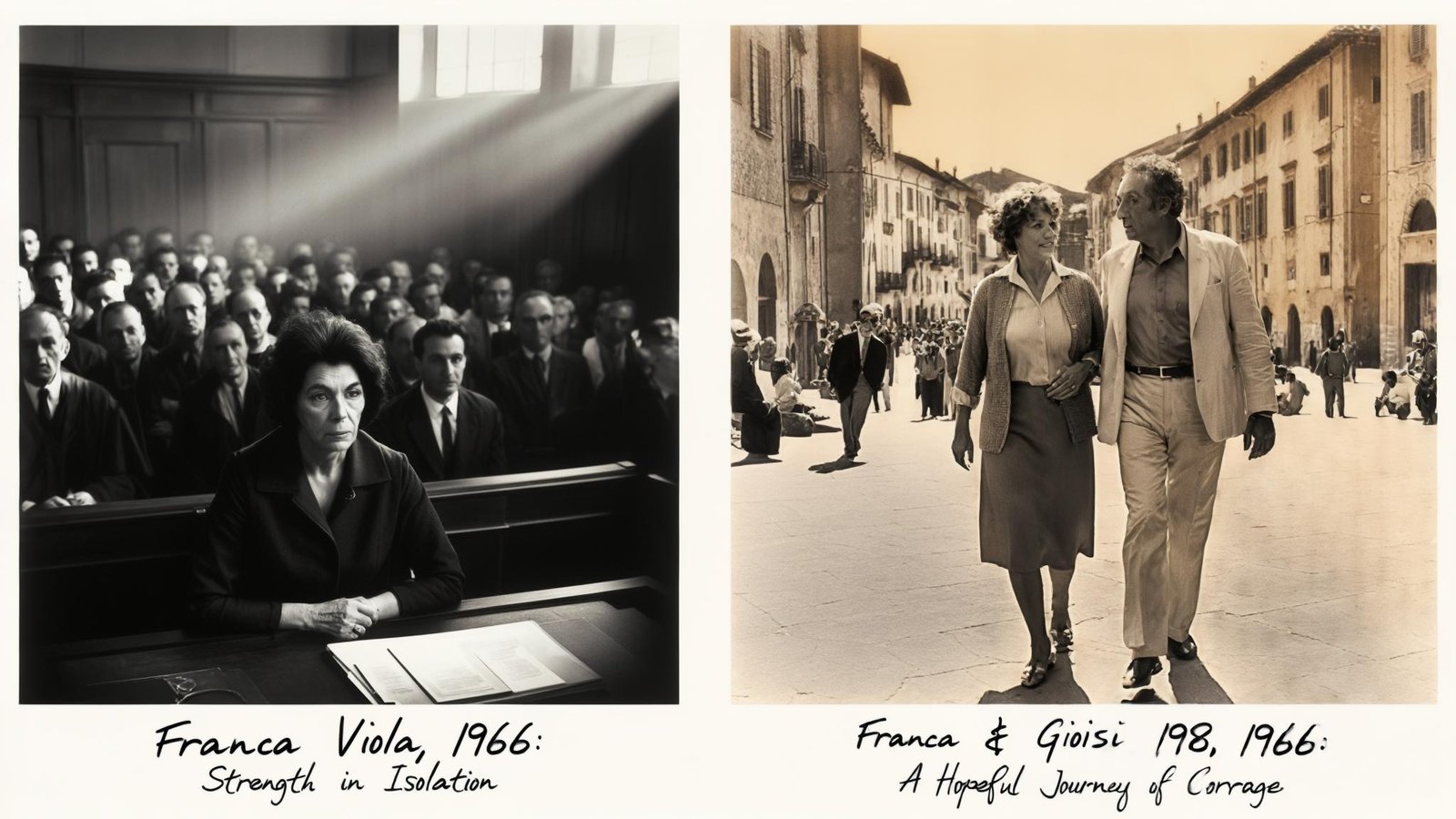
With her father’s support, she refused to marry Filippo Melodia. Instead, she did something unprecedented: she pressed charges. She took him to court.
The backlash was immediate and brutal. Her family was shunned. Their fields were set on fire. Their name became synonymous with dishonor. In Sicily, where honor codes ran deep and mafia influence was strong, defying this tradition was dangerous.
But Franca didn’t back down.
The trial became a national sensation. For the first time, Italians across the country had to confront the horror of a law that protected rapists and punished victims. Newspapers covered every detail. The country divided between those who supported Franca’s courage and those who condemned her for “shaming” herself and her family.
In 1966, Filippo Melodia was convicted and sentenced to eleven years in prison.
Franca Viola became the first woman in Italian history to publicly refuse “rehabilitating marriage” and successfully prosecute her rapist.
The cultural shift was seismic. Italy’s President Giuseppe Saragat received her. Pope Paul VI—the Pope himself—met with her, a quiet acknowledgment that the Church recognized something fundamental was changing.
In 1968, Franca married Giuseppe Ruisi, her childhood friend who loved her without prejudice, who saw her as a whole person rather than a “dishonored” woman. Their marriage was a statement: victims of violence deserved love, respect, and normal lives.
But the law didn’t change immediately. Article 544 remained on the books.
It took fifteen more years. Fifteen years of activism, of cultural shifts, of other women finding courage in Franca’s example. Finally, in 1981, the Italian Parliament abolished the “rehabilitating marriage” law.
Rapists could no longer escape justice by marrying their victims.
Franca Viola, a 17-year-old girl from Sicily who simply said “no,” had helped change the law of an entire nation.
She never sought fame. She lives quietly with Giuseppe, their children and grandchildren. She rarely gives interviews. She was never interested in being a symbol—she just wanted justice for what happened to her.
But history made her a symbol anyway.
Because sometimes one person’s refusal to accept injustice can crack open an entire system. Sometimes a teenage girl’s courage can force a modern nation to confront laws built on ancient shame and patriarchal control.
Franca Viola proved that a woman’s honor isn’t defined by what’s done to her—it’s defined by how she responds.
She was 17 years old. The law, her community, tradition, and fear all told her to submit.
She said no.
And Italy changed forever.