
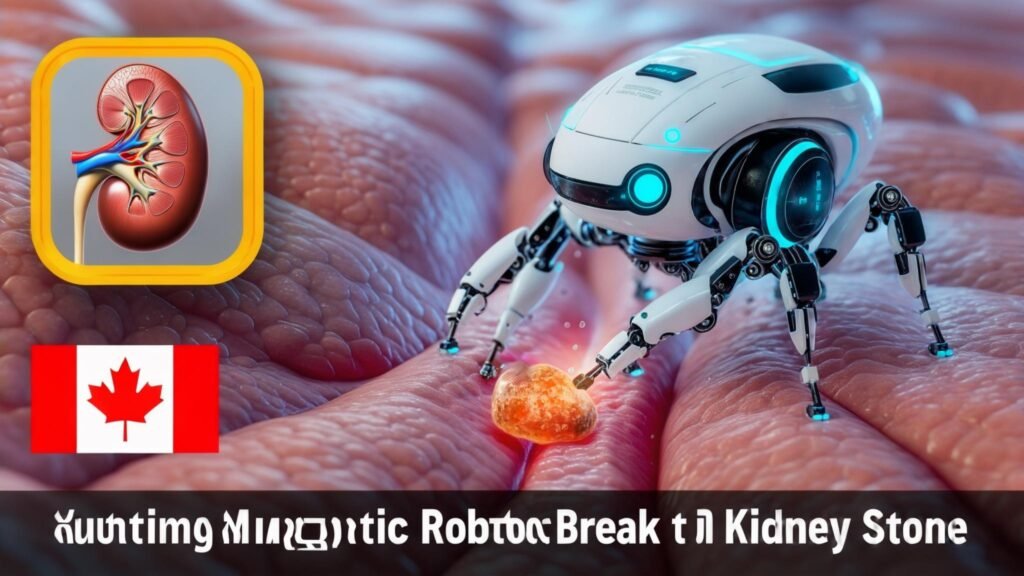
Robotic Kidney Stone Treatment: Non-Invasive & Surgery-Free
Researchers at the University of Waterloo in Canada announced a major medical breakthrough: a rice-sized, magnetic “soft robot” designed to dissolve kidney stones without the need for invasive surgery.
This innovative device, roughly one centimeter long and shaped like a thin strip of spaghetti, is made of a flexible, gelatin-based material that can be guided through the urinary tract using external magnets.
How the Tiny Robot Works
Targeted Navigation: Guided by a motorized magnetic arm and real-time ultrasound imaging, doctors can steer the robot precisely to the location of the kidney stone.
Chemical Dissolution: The robot is loaded with urease, an enzyme that reacts with urea in the urine to raise local pH levels. This makes the environment more basic, which helps to gradually dissolve uric acid stones until they are small enough to pass naturally.
Fast Recovery: Unlike traditional treatments like shock wave lithotripsy or surgery, this method targets only the stone and avoids damaging healthy tissue. Lab tests on 3D-printed models showed that stones could lose 30% of their mass in just five days, providing a much faster alternative to months of oral medication.
Why This Technology Matters
This discovery is particularly important for “recurring stone formers”—the 12% of the population who suffer from frequent stones and often face multiple painful surgeries.
By providing a minimally invasive and targeted treatment, the Waterloo team, led by Dr. Veronika Magdanz, aims to eliminate the need for incisions, stents, and general anesthesia.
The project is the first of its kind to successfully use micro-robotics for the local dissolution of kidney stones, offering hope for a “pain-free” future for patients worldwide.