
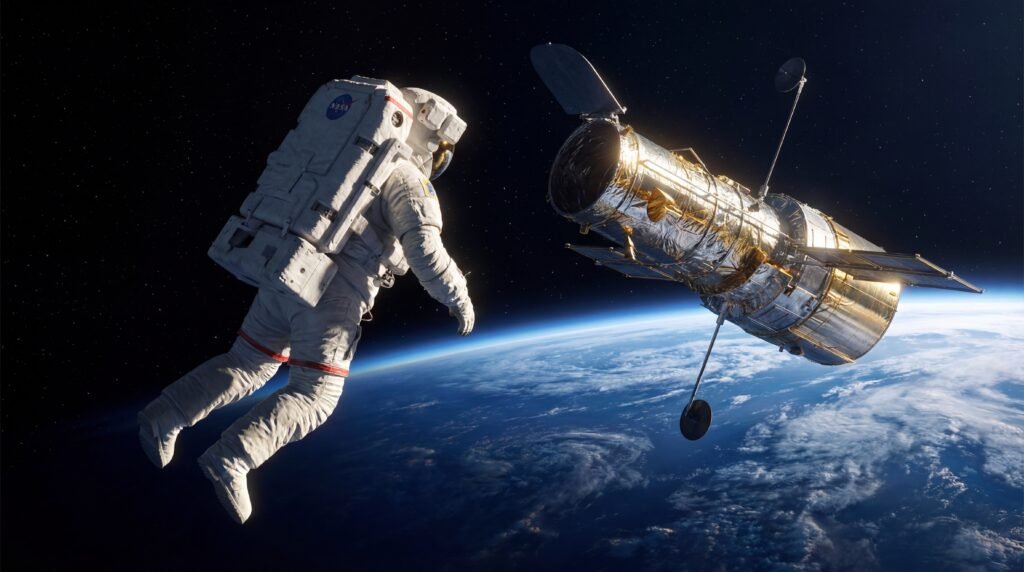
How Dale Gardner Mastered the Untethered Spacewalk
In February 1984, astronaut Dale Gardner carried out one of the most audacious recoveries ever attempted in orbit, during NASA’s STS-51-A mission aboard Space Shuttle Discovery.
The target was Westar VI, a communications satellite that had failed to reach its proper orbit and was left slowly tumbling, useless, above Earth. Rather than abandon the spacecraft, NASA approved a daring plan: retrieve it by hand.
Gardner relied on the Manned Maneuvering Unit (MMU)—a nitrogen-thruster backpack that allowed astronauts to fly freely in space without a tether. Leaving the safety of the shuttle, he maneuvered across open vacuum, stabilizing himself entirely through controlled bursts of thrust. There was no physical connection to the spacecraft behind him—only precision, training, and calm judgment.
Approaching the spinning satellite, Gardner executed a carefully rehearsed sequence, attaching a custom-built capture device to Westar VI. Once secured, he guided the satellite back to Discovery’s payload bay, where it was locked in place for return to Earth and refurbishment.
The operation was a landmark moment in human spaceflight. It demonstrated that astronauts could perform complex, delicate tasks while flying untethered—an extraordinary display of control in one of the most unforgiving environments imaginable. Though the MMU was later retired, the mission remains a defining example of human ingenuity and confidence beyond Earth.