Sergei Krikalev: The “Last Soviet Citizen” Trapped in Space
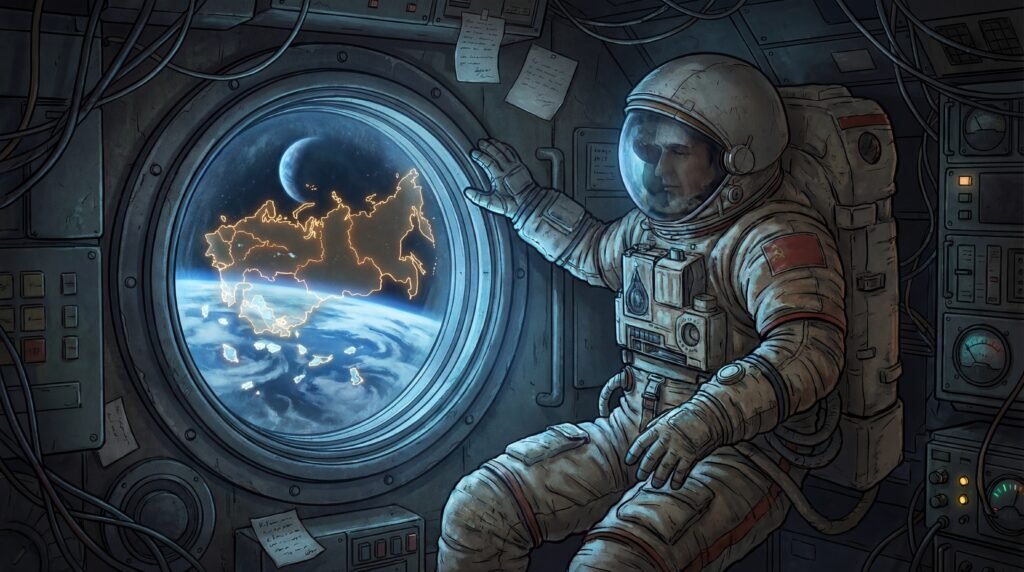
Soviet Cosmonaut Sergei Krikalev was stuck in space during the collapse of the Soviet Union, December 26, 1991.
The Baikonur Cosmodrome, from where the Soviets launched their rockets, now belonged to a newly independent Kazakhstan and they were demanding exorbitant fees for the use of their facilities. Meanwhile Russia’s economy was collapsing and so they attempted to raise funds by selling off space station trips to the highest bidders. Austria paid $7 million for a seat and a Japanese TV network paid $12 million to send one of its reporters to space. Moscow was also able to negotiate a deal with Kazakhstan to fly the first ever Kazakh cosmonaut in exchange for launch permission from the Baikonur Cosmodrome.
However, the Austrian and Kazakh astronauts were relatively inexperienced and were not qualified to replace Krikalev, who reluctantly agreed to stay behind to man the station while his partner Aleksandr Volkov flew back home.
A Russian newspaper wrote, “A human race sent its son off to the stars to fulfill a concrete set of tasks, but hardly had he left Earth then it lost interest in those tasks, for worldly and completely explicable reasons. And it started to forget about its cosmonaut. It did not even fetch him back at the appointed time, again for completely worldly reasons.”
Once a week, Krikalev kept in touch with his wife, Elena, who worked at mission control. The value of the Soviet Ruble had fallen dramatically and Krikalev’s monthly salary of 500 rubles was barely enough to keep his family afloat. Moreover, the Russians struggled to send over essential supplies to the stranded cosmonaut.
On March 25, 1992, after spending 311 days in orbit, Krikalev returned back to earth. By then, his country had fractured into 15 different nations.
Discover magazine wrote, “He was pale as flour and sweaty, like a lump of wet dough. The cosmonauts were wrapped in fur-lined coats and placed on chairs. Someone handed them hot broth to drink. Years later, Krikalev recalled, ‘It was very pleasant in spite of the gravity we had to face, but psychologically, the load was lifted. There was a moment. You couldn’t call it euphoria, but it was very good.'”